
Applying through Express Entry can be one of the most important steps toward Canadian permanent residence. However, it is not a process where applicants should
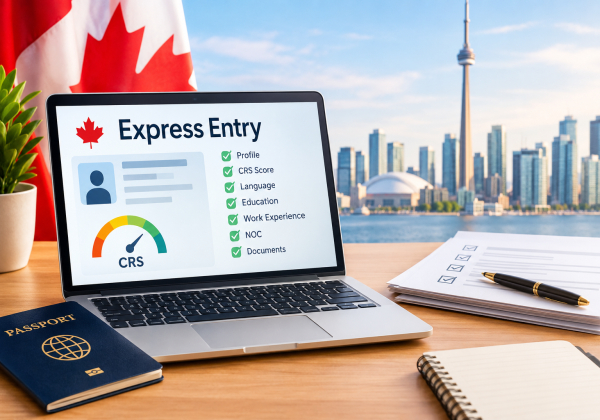
Applying through Express Entry can be one of the most important steps toward Canadian permanent residence. However, it is not a process where applicants should submit a profile, make assumptions, and correct mistakes later. Express Entry is a structured immigration system. Your eligibility, CRS score, language results, education, NOC, work experience, documents, and personal information all need to support the same application story.
A high CRS score can help you receive an Invitation to Apply (ITA), but receiving an ITA does not automatically mean your permanent residence application will be approved. IRCC still assesses whether you meet the requirements and whether the information and documents you provided support your claims. For that reason, a strong profile strategy should begin before you create your Express Entry profile not after you receive an invitation.
Why Express Entry Is Not a Trial and Error Process
Many applicants treat Express Entry like a points game. They calculate their CRS score, enter the pool, and hope for an ITA. That approach can create problems. Express Entry uses different types of invitation rounds, including general, program-specific and category-based rounds. IRCC selects candidates according to the requirements of each round and their ranking in the pool. For example, in 2026, IRCC held a Canadian Experience Class round on June 23 with a CRS cut-off of 516 and another CEC round on August 18 with a cut-off of 523. A French-language category round on July 9 had a cut-off of 420, while a healthcare and social services category round on September 4 had a cut-off of 475. These examples show why there is no single CRS score that guarantees an ITA. Therefore, applicants should look beyond a single CRS number.
The real question is:
Does your entire profile accurately support the program and category you are relying on?
Your CRS Score Is Important but It Is Not Everything
The Comprehensive Ranking System (CRS) is used to rank candidates in the Express Entry pool.
Your score can be affected by factors such as:
- Age
- Education
- Language ability
- Canadian work experience
- Foreign work experience
- Certain combinations of education and language
- Certain combinations of Canadian and foreign work experience
- Other eligible factors under the CRS
However, a strong CRS score does not replace basic eligibility. An applicant may calculate a competitive score but later discover that their claimed work experience does not meet the requirements of the program. Similarly, a language result may provide CRS points but still be invalid if the test has expired when required. IRCC specifically notes that a profile can become ineligible while a person remains in the pool. Examples include work experience no longer meeting program requirements, expired language results, expired ECA results, insufficient funds, or a change in primary occupation.That is why your CRS calculation should be treated as part of a wider application review.

CEC and FSW Are Not the Same
Two major Express Entry pathways are the Canadian Experience Class (CEC) and Federal Skilled Worker Program (FSW). The CEC is designed for people with qualifying Canadian work experience. The FSW program is designed for skilled workers with qualifying work experience in Canada or abroad. The requirements are different. For example, IRCC currently requires CEC applicants to have Canadian work experience in eligible NOC TEER 0, 1, 2 or 3 occupations. The minimum language requirement is CLB 7 for TEER 0 and 1 occupations and CLB 5 for TEER 2 and 3 occupations.
For FSW applicants, qualifying skilled work experience generally needs to be in TEER 0, 1, 2 or 3, and the applicant must meet the program’s work experience, language and education requirements. For foreign education, an Educational Credential Assessment (ECA) is generally required for immigration purposes. This difference matters.
Someone should not simply select CEC or FSW because it appears to be the easiest option. The correct program depends on the applicant’s actual history and the applicable requirements.
Your NOC Must Match Your Actual Work
Choosing the right NOC is one of the most important parts of an Express Entry application.A common mistake is choosing a NOC based mainly on the job title. However, job titles can vary between companies and countries. What matters is whether your actual duties and responsibilities align with the selected occupation.
For FSW, IRCC states that the applicant’s work experience must include the actions described in the NOC lead statement and most of the main duties listed for the occupation. The experience must also meet requirements related to skill level, duration, payment and timing. This means your employment letter should not simply confirm that you worked for a company. Your documentation should help demonstrate what you actually did.
Before selecting a NOC, review:
- Your job title
- Your actual daily duties
- Your employment dates
- Your working hours
- Your salary or compensation
- Your employer information
- The NOC lead statement
- The main duties listed under the NOC
A NOC selected only because its title sounds similar to your job can create unnecessary refusal risk.
Work Experience Must Be Genuine and Verifiable
Work experience is another area where applicants should avoid assumptions. For FSW, qualifying skilled work generally must be paid work and must meet specific requirements. IRCC currently states that applicants can qualify through at least one year of continuous work or an equivalent total of 1,560 hours, subject to the program’s rules. The important point is that the number of years alone does not tell the whole story.
For example, saying that you have “five years of experience” is not enough. The immigration officer needs to assess whether the experience meets the applicable program requirements.
Your employment evidence may need to establish details such as:
- Position
- Duties
- Employment dates
- Hours worked
- Salary
- Employer information
- Work location
If your documents contain inconsistencies, address them before submission rather than hoping they will not be noticed.
IELTS, CELPIP and PTE: Small Details Matter
Language testing is another area where applicants sometimes make avoidable mistakes. For Express Entry, IRCC currently accepts approved English tests including IELTS General Training, CELPIP-General and PTE Core. French applicants can use TEF Canada or TCF Canada. Notice the details.
For IELTS, Express Entry requires the General Training option. IRCC states that IELTS One Skill Retake is not accepted for Express Entry. For PTE, applicants need the PTE Core option. Your results also need to remain valid when required.
A test that helped you create your profile may become invalid while you are waiting in the pool or preparing your application. IRCC specifically lists expired language results as one reason a profile may become ineligible. Therefore, track your test expiry date carefully.
ECA Is More Than a Checkbox
If you completed your education outside Canada, an Educational Credential Assessment (ECA) can be an important part of your Express Entry application. For FSW applicants with foreign education, IRCC requires an ECA for immigration purposes.
Applicants should make sure they understand:
- Which credential is being assessed
- Whether the assessment is for immigration purposes
- Whether the issuing organization is accepted
- Whether the assessment remains valid
- Whether the information entered in the Express Entry profile matches the assessment
Do not assume that every educational assessment can be used for Express Entry.
Proof of Funds Can Become a Problem
Proof of funds is another requirement that should not be treated as an afterthought.
For FSW applicants, IRCC states that applicants generally need to show enough money to settle in Canada, with exceptions such as certain applicants who are legally able to work in Canada and have a valid job offer from a Canadian employer. Your financial situation can also change while you are in the pool. IRCC specifically advises candidates that they may need to update their proof of funds and lists insufficient funds as a possible reason a profile can become ineligible. Therefore, do not check your funds only on the day you create your profile. Continue monitoring the requirement until you submit your permanent residence application.
Receiving an ITA Does Not Mean the Application Is Approved
This is one of the most important points for Express Entry applicants. An Invitation to Apply (ITA) gives you an opportunity to submit a permanent residence application. It is not a guarantee of approval. After receiving an ITA, you must submit your application within the applicable deadline. IRCC states that if an applicant does not apply within 60 days, the invitation expires and the profile is removed from the pool. At this stage, document accuracy becomes even more important. Your final application should support the information you entered in your Express Entry profile.
If your profile says you have certain work experience, your supporting documents should demonstrate that experience. If your profile claims a particular education credential, your documents should support it. If your CRS score depends on a specific language result, the result must be valid and correctly reported. The application should tell one consistent story from beginning to end.
Common Express Entry Mistakes That Increase Refusal Risk
Applicants should carefully review their application for issues such as:
1. Choosing a NOC based only on the job title
Your job title may not accurately identify the correct NOC. Compare your actual duties with the NOC requirements.
2. Claiming work experience that cannot be properly documented
Experience should be supported with credible documentation and meet the relevant program rules.
3. Entering incorrect language scores
Even a small data-entry mistake can create problems if the profile does not accurately reflect your official test result.
4. Using the wrong language test
IELTS General Training, CELPIP-General and PTE Core are different from other versions. Check the current IRCC requirements before submitting your results.
5. Ignoring document expiry dates
Language results and ECAs have validity periods. Your eligibility can change while you remain in the pool.
6. Treating CRS as the only strategy
A CRS calculation is useful, but it should be combined with an eligibility and documentation review.
7. Waiting until after the ITA to identify problems
Once you receive an ITA, you have a limited period to prepare and submit the application. Finding a major documentation problem at that point can create unnecessary pressure.
A Better Express Entry Profile Strategy
A careful strategy can reduce avoidable problems. Start with eligibility. Determine whether you qualify under CEC, FSW or another applicable Express Entry pathway. Next, review your NOC and work experience. Do not select an occupation simply because the title appears similar. Compare your actual duties with the NOC requirements. Then verify your language results and ECA. Make sure the correct test, scores, dates and credential information are entered. After that, calculate your CRS score. Do not rely on an estimated score without checking the underlying information. Finally, review your proof of funds and supporting documents. This process creates a stronger foundation than simply entering the Express Entry pool and hoping to fix issues later.
Why Professional Review Can Help
Express Entry rules contain several moving parts. A single profile can involve education, work history, language testing, NOC selection, CRS calculations, family information and financial documentation. A professional review can help identify inconsistencies before submission. This does not mean an applicant should blindly rely on someone else. You should understand the information being submitted on your behalf and verify that it is accurate.
The goal is simple:
Build the application around your real qualifications and evidence not around the CRS score you want to achieve.
Frequently Asked Questions
Is Express Entry guaranteed if I have a high CRS score?
No. A CRS score determines ranking in the pool for applicable invitation rounds. Candidates must also meet the requirements of the relevant program or category, and an ITA does not guarantee permanent residence approval.
What is the difference between CEC and FSW?
CEC focuses on qualifying Canadian work experience, while FSW is designed for skilled workers with qualifying work experience in Canada or abroad. Each program has its own eligibility requirements.
Which English tests are accepted for Express Entry?
IRCC currently accepts CELPIP-General, IELTS General Training and PTE Core for English. IELTS One Skill Retake is not accepted for Express Entry.
Do I need an ECA for Express Entry?
If you are relying on foreign education under a program such as FSW, you generally need an Educational Credential Assessment for immigration purposes. Canadian education follows different rules.
Can I choose any NOC that gives me a better CRS score?
You should select the NOC that accurately reflects your actual work experience and duties. Choosing a NOC simply because it produces a preferred result can create serious documentation and eligibility issues. IRCC requires qualifying work experience to align with the relevant NOC requirements.
How long is an Express Entry ITA valid?
If you receive an ITA and do not submit your application within 60 days, the invitation expires and your profile is removed from the pool.
Can my Express Entry profile become ineligible after I enter the pool?
Yes. IRCC lists several situations that can affect eligibility, including expired language tests or ECAs, insufficient funds, changes in work experience and changes to the primary occupation.
Can I improve my CRS score after creating my profile?
Yes. IRCC notes that candidates can take steps to improve their score, such as improving language results or pursuing other eligible factors. However, the effect depends on your individual circumstances and the current Express Entry rules.
Conclusion: Build Your Express Entry Application Carefully
Express Entry should not be approached as a trial-and-error process. Your CRS score matters, but it is only one part of the application. Your CEC or FSW eligibility, NOC, work experience, IELTS/CELPIP/PTE results, ECA, proof of funds and supporting documents all need to work together. Most importantly, the information in your profile should be accurate and supported by evidence. Before creating your profile, review your eligibility. Before accepting an ITA, review your documents. Before submitting your permanent residence application, review everything again. A careful profile strategy can help you identify potential issues early and reduce avoidable refusal risk.
Need Help Reviewing Your Express Entry Profile?
If you are unsure about your CRS score, NOC selection, CEC or FSW eligibility, work experience, language results, ECA or proof of funds, getting your profile reviewed before submission can help you understand where potential issues may exist.
Book a consultation today to review your Express Entry profile and build a document-focused application strategy based on your individual circumstances.


