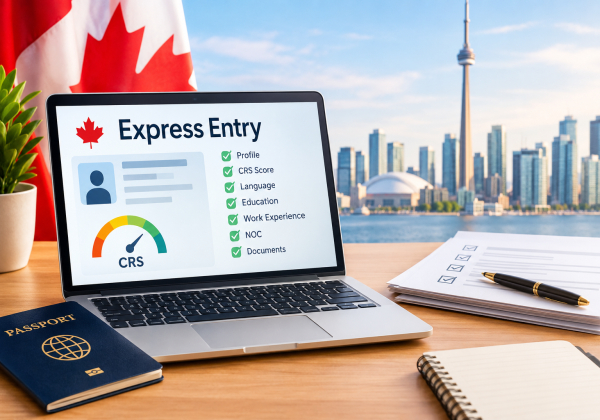
Moving to Canada for study or work can be a major step for you and your family. One of the most common questions applicants have

Moving to Canada for study or work can be a major step for you and your family. One of the most common questions applicants have is whether their spouse can also work in Canada after they arrive.
The answer is sometimes yes, but not automatically.
A spouse or common-law partner may qualify for a Spousal Open Work Permit (SOWP) if they meet the requirements of the immigration category they are applying under. However, Canada has changed the rules for spouses of international students and foreign workers in recent years. Because of these changes, simply having a study permit or work permit does not always mean your spouse will receive work authorization. Your eligibility can depend on your study program, occupation, NOC/TEER category, work permit validity, and whether you are following a pathway to permanent residence. This guide explains the current rules, who may qualify, what documents are usually required, and how a spouse work permit can fit into a long-term PR pathway.
What Is a Spousal Open Work Permit?
A Spousal Open Work Permit, commonly called an SOWP, allows an eligible spouse or common-law partner to work for most employers in Canada without first obtaining a job-specific work permit.Unlike an employer-specific work permit, an open work permit generally does not require the applicant to have a Canadian job offer before applying. However, an open work permit is available only to people who qualify under an eligible immigration category. This distinction is important.
Being married to someone who is studying or working in Canada does not automatically give the spouse work authorization. The spouse must submit their own application and meet the applicable eligibility requirements.
Can Your Spouse Get an SOWP After You Come to Canada?
Yes, your spouse may be able to apply for a Spousal Open Work Permit after you come to Canada, but eligibility depends on your situation.
There are two major situations to consider:
- You are an international student in Canada.
- You are a foreign worker in Canada.
The rules are different for each group. Therefore, before your spouse submits an application, it is important to check the specific rules that apply to your study permit or work permit.
SOWP for Spouses of International Students
Canada changed the eligibility rules for spouses of international students beginning January 21, 2025. Under the current IRCC rules, a spouse or common-law partner may qualify for an open work permit when the student has a valid study permit and is studying in certain eligible programs.
Eligible master’s programs
If you are studying in Canada in a master’s degree program lasting 16 months or longer, your spouse may be eligible for an open work permit. The program must meet the applicable requirements, and you must have a valid study permit.
Doctoral programs
Spouses of students enrolled in a doctoral degree program may also qualify for an SOWP under the current rules.
Certain professional degree programs
The rules also cover specific professional degree programs at universities. These include programs such as:
- Doctor of Dental Surgery
- Bachelor of Law or Juris Doctor
- Doctor of Medicine
- Doctor of Optometry
- Pharmacy
- Doctor of Veterinary Medicine
- Bachelor of Science in Nursing
- Bachelor of Nursing
- Bachelor of Education
- Bachelor of Engineering
The exact program and institution matter, so applicants should verify that their studies fall within the eligible categories before relying on this route.
Other eligible programs
IRCC also identifies certain special programs and pilots that can make a student’s spouse eligible for an open work permit. These include specific programs connected with areas such as nursing, pharmacy, midwifery and other specialized training. This means that choosing a Canadian study program only because a spouse wants work authorization can be risky. The program should be checked against the current IRCC eligibility list.
What If You Are Studying in a Regular College Program?
This is where many applicants become confused. Not every international student can bring a spouse who automatically qualifies for an SOWP. The current rules focus on specific master’s, doctoral, professional and eligible programs. Therefore, a spouse of a student in another type of program may not qualify under the student-spouse open work permit category. If your spouse is not eligible for an SOWP, that does not necessarily mean they cannot come to Canada. Depending on their circumstances, they may have other options, including applying for a different type of work permit, studying, or visiting Canada.
The key point is to separate entry to Canada from work authorization. A spouse may be allowed to accompany you without automatically having permission to work.
SOWP for Spouses of Foreign Workers
The rules for a foreign worker spouse are also more specific than they were in the past. For many foreign workers, eligibility depends on the worker’s occupation, NOC/TEER category, work permit validity and, in some cases, whether the worker is pursuing a permanent residence pathway.
Understanding NOC and TEER
Canada uses the National Occupational Classification (NOC) system to classify jobs. The current system uses TEER categories, which means Training, Education, Experience and Responsibilities.
Generally:
- TEER 0 – management occupations
- TEER 1 – professional occupations
- TEER 2 – technical occupations and skilled trades
- TEER 3 – occupations requiring specific training or experience
- TEER 4 and 5 – occupations generally requiring lower levels of formal education or training
IRCC distinguishes between high-skilled and low-skilled occupations when assessing certain family open work permit applications. TEER 0, 1, 2 and 3 are treated as high-skilled for this purpose, while TEER 4 and 5 are treated as low-skilled. However, simply being in TEER 0–3 does not mean the spouse automatically qualifies.
Some TEER 2 and TEER 3 occupations are specifically identified by IRCC for certain foreign-worker spouse applications.
What Are the Requirements for a Foreign Worker Spouse?
For certain high-skilled foreign workers who are not applying through an eligible PR pathway, the principal worker generally needs to meet several conditions. The worker must have a valid work permit, approval for a work permit, or qualifying authorization to work. They must also be living or planning to live in Canada while working. In addition, the worker must be employed or expected to be employed in an eligible occupation. For the applicable category, this can include TEER 0 or 1 occupations and certain selected TEER 2 and TEER 3 occupations.
Another important requirement is the validity period of the worker’s authorization. In the standard high-skilled worker category, the work permit or work authorization generally needs to remain valid for at least 16 months after IRCC receives the spouse’s open work permit application, subject to specific exceptions.
This is why checking only the job title is not enough. The actual NOC code, TEER category, work permit status and remaining validity can all matter.
What If the Foreign Worker Is on a PR Pathway?
A foreign worker who is already pursuing an eligible permanent residence pathway may have another route for their spouse.
IRCC has specific provisions for family members of workers who have applied for permanent residence through certain economic immigration programs and pilots. These can include programs such as:
- Canadian Experience Class
- Federal Skilled Worker Class
- Federal Skilled Trades Class
- Provincial Nominee Program
- Atlantic Immigration Program
- Agri-Food Pilot
- Start-Up Visa Program
- Certain other eligible programs and pilots
Under this category, the principal worker generally needs a valid work permit or approval for one, and the permit must be valid for at least six months after IRCC receives the family member’s application. Other requirements also apply. This makes the PR pathway an important part of the eligibility assessment.
For example, two workers with similar jobs could have different family work-permit options because they are at different stages of their immigration process.
What If You Are a Low-Skilled Worker?
This is another area where applicants need to be careful. Under the current rules, spouses of low-skilled workers who are not on an eligible pathway to permanent residence generally cannot apply for a new open work permit through the standard family-member measure.
IRCC classifies TEER 4 and TEER 5 occupations as low-skilled for this purpose. There are, however, specific immigration pathways and exceptions that can change the analysis. For example, family members may have different options where the principal applicant is on an eligible pathway to permanent residence or falls under a special program. Therefore, applicants should not assume that a TEER 4 or 5 job automatically means there are no options. The complete immigration profile should be reviewed.
What Documents Does Your Spouse Need?
The exact document checklist depends on the application and the applicant’s circumstances. However, common supporting evidence can include:
Proof of relationship
Your spouse may need to provide evidence showing that the relationship is genuine. This could include a marriage certificate or other relationship documents requested by IRCC.
Your immigration documents
Depending on the category, your spouse may need documents such as:
- Study permit
- Work permit
- Letter of introduction
- Proof of employment
- Proof of enrolment
- Letter of acceptance
- NOC/TEER information
- PR application documents
- Proof of permanent residence application, where applicable
For international students, IRCC specifically lists documents such as a valid letter of acceptance, proof of enrolment or transcripts to demonstrate enrolment in the eligible program.
For foreign-worker applications, documents demonstrating the worker’s employment, work authorization and applicable immigration pathway may be important.
When Should Your Spouse Apply?
Your spouse does not necessarily have to apply at exactly the same time as you. If you have already arrived in Canada and your spouse remains outside Canada, they may apply separately if they meet the requirements. The application should be based on your current immigration status and the rules in effect when the application is submitted.
This is particularly important because Canadian immigration policies can change.If your eligibility depends on your study program, work occupation or PR application, make sure the supporting documents clearly demonstrate that connection.
How Long Can the Spouse Work Permit Be Valid?
The validity period depends on the category and circumstances. For spouses of eligible international students, IRCC says the open work permit will most of the time be valid for the same period as the student’s study permit. For foreign workers, the validity can depend on the principal applicant’s work authorization and the specific program.
A spouse’s passport validity can also affect the maximum period for which a permit can be issued. This is one reason applicants should check passport validity before submitting an application.
Can an SOWP Help With a PR Pathway?
It can be part of a family’s broader Canadian immigration plan, but an SOWP itself does not guarantee permanent residence. A spouse who receives work authorization may gain Canadian work experience, but whether that experience can support a PR application depends on the specific immigration program and its requirements.
For example, Canada’s economic immigration programs may assess factors such as:
- Skilled Canadian work experience
- Occupation
- Language ability
- Education
- Age
- Provincial nomination
- CRS score
- Program-specific eligibility
Therefore, families should think about work authorization and permanent residence as two connected but separate immigration questions.Getting an SOWP does not automatically create a PR pathway.
Common Mistakes to Avoid
1. Assuming every student can get an SOWP
The current rules limit eligibility to specific study programs and categories.
2. Checking only the job title
For foreign workers, the NOC and TEER classification can be important. The same general job description may not be enough to determine eligibility.
3. Ignoring work permit validity
A worker’s remaining work authorization can affect whether their spouse qualifies.
4. Using outdated immigration information
Canadian immigration rules have changed significantly. Information published before January 21, 2025, may not reflect the current student-spouse rules.
5. Treating an SOWP as automatic work authorization
Your spouse must receive the appropriate work authorization before starting work in Canada. Simply entering Canada as a visitor or family member does not automatically provide work authorization.
6. Choosing a study program without checking spouse eligibility
If bringing a spouse who wants to work is an important part of your plan, check the current IRCC rules before choosing a program.
Frequently Asked Questions
Can my spouse get an open work permit after I arrive in Canada?
Yes, potentially. Your spouse can apply separately after you arrive if they meet the requirements of an eligible SOWP category. Eligibility depends on whether you are an international student, foreign worker or fall under another qualifying immigration pathway.
Can the spouse of an international student get an SOWP?
Some can. Current rules generally cover spouses of students in eligible master’s programs of at least 16 months, doctoral programs, certain professional degree programs and specified eligible programs.
Can my spouse work if I have a study permit?
Not simply because you have a study permit. Your study program must meet the applicable eligibility requirements, and your spouse must submit their own work permit application.
Does my spouse need a job offer for an SOWP?
An open work permit generally does not require a job offer from a Canadian employer. However, the spouse must first qualify for the open work permit category.
Does NOC/TEER affect a spouse work permit?
Yes. For certain foreign-worker categories, IRCC uses NOC and TEER classifications to determine whether the principal worker’s occupation is eligible.
Can a TEER 4 or TEER 5 worker bring a spouse with an open work permit?
Generally, spouses of low-skilled workers who are not on an eligible PR pathway are not eligible for a new open work permit under the standard family-member measure. However, other programs or pathways may apply in specific cases.
Does an SOWP guarantee permanent residence?
No. An SOWP provides work authorization when approved, but it does not guarantee permanent residence. PR eligibility must be assessed separately under the applicable immigration program.
Can my spouse extend an existing SOWP?
In some situations, yes. For spouses of international students, the student generally needs to continue meeting the relevant study requirements, including being a full-time student in a PGWP-eligible program and not being in the final term.
What if my spouse is not eligible for an SOWP?
They may have other options depending on their circumstances. These could include an employer-specific work permit, study permit or visitor status. The correct option depends on the person’s eligibility and immigration goals.
Final Thoughts
The answer to “Can your spouse get an open work permit after you come to Canada?” is not simply yes or no.
For an international student, your study program is one of the most important factors. For a foreign worker, your NOC/TEER category, work permit validity and immigration pathway can be critical. Canada’s immigration changes have made it especially important to use current information rather than relying on older SOWP advice.
If your spouse plans to work in Canada, review your study permit or work permit, your program or occupation, the applicable NOC/TEER classification and your potential PR pathway before submitting an application.
Planning your move to Canada? Get your eligibility reviewed before applying so you can understand which spouse work permit options may apply to your situation and avoid relying on outdated immigration information.